Nobody takes lion’s mane for a week. The research that reported anything useful ran for a month or more — and the one trial that tested a single dose measured something quite narrow. Here is what the timelines in the studies actually look like.
The short answer
- Within an hour: one small trial measured faster performance on a reaction-and-interference task after a single 1.8 g dose. That is a lab task, not a feeling you will notice.
- Four weeks: the shortest trial to report differences in mood and anxiety scores.
- Twelve to sixteen weeks: where the cognitive trials reported their clearest differences, with the gap widening over time.
- Four weeks after stopping: the improvement faded back toward baseline in the one trial that measured a washout.
If you want a single number to plan around: give it a month before you judge it, and expect it to be something you keep taking rather than a course you finish.
What each study found, and when
The acute study: within an hour
Docherty and colleagues (2023) gave healthy young adults a single 1.8 g dose and tested them shortly after. The group that took lion’s mane completed a Stroop task faster. After 28 days of daily supplementation the same participants reported lower subjective stress.
Two caveats worth holding onto: it was a pilot study with a small sample, and « faster on a Stroop task » is not the same as « you will feel sharper at your desk ».
Four weeks: mood measures
Nagano and colleagues (2010) gave 30 menopausal women lion’s mane powder baked into cookies for four weeks and reported lower scores on depression and anxiety questionnaires. Self-reported measures, small sample, short window — the weakest kind of evidence that still counts as evidence, but it does put four weeks on the map as a point where something was measurable.
Twelve to sixteen weeks: the cognitive trials
Mori and colleagues (2009) ran 16 weeks in adults with mild cognitive impairment at 3 g a day. The difference from placebo grew as the weeks went on — it was not a step change at week two. Saitsu and colleagues (2019) ran 12 weeks at 3.2 g a day in healthy adults and also reported improvement on cognitive testing.
The pattern across both: this is a slope, not a switch.
The washout result, and why it matters for your planning
The most practically useful detail in the whole literature is easy to miss. In Mori’s trial, participants were tested again four weeks after they stopped taking it — and their scores had fallen back.
That tells you two things. First, the effect measured was probably real rather than a testing artefact, because it tracked intake. Second, and more usefully: there is no evidence of a lasting benefit you bank and then keep. If you want whatever this does, you keep taking it.

Gélules de crinière de lion 100 pcs, 600–650 mg | Hericium erinaceus
La crinière de lion (Hericium erinaceus) contient deux composés uniques — les érinacines et les héricénones — qui stimulent la synthèse du facteur de croissance nerveuse (NGF). Soutient la santé du cerveau, la mémoire, la concentration et la fonction cognitive. Nos gélules contiennent 600 à 650 mg de crinière de lion pure. 100 gélules par flacon.
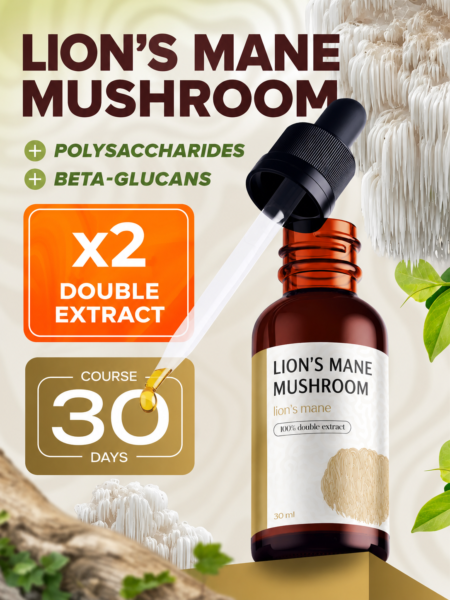
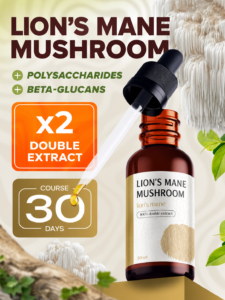
Double extrait de crinière de lion 30 ml | Soutien du cerveau et de la mémoire | Teinture d'Hericium erinaceus
Puissante teinture de crinière de lion à double extraction, associant extraction à l'eau et à l'alcool pour une biodisponibilité maximale des héricénones et des bêta-glucanes. Soutient la fonction cognitive, la régénération nerveuse et la clarté mentale. ! Sans alcool
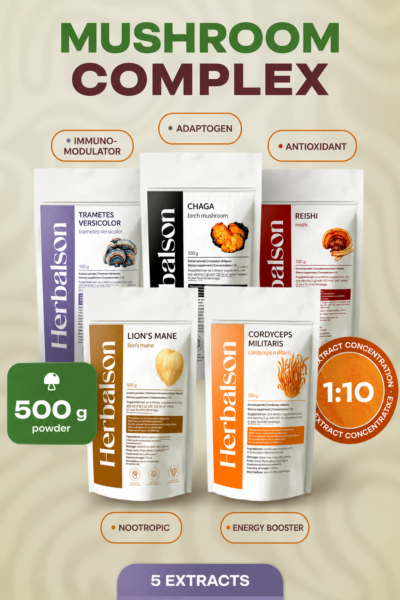
Coffret de poudres de champignons : crinière de lion, cordyceps, reishi, tramète versicolore et chaga | 5×100 g
Un ensemble complet de 5 poudres de champignons fonctionnels : crinière de lion, cordyceps, reishi, tramète versicolore et chaga (100 g chacune). Parfait pour les smoothies, le thé ou la cuisine. Chaque poudre est issue de corps fructifères entiers, séchés et finement moulus pour préserver les composés bioactifs.
Why you might feel nothing at all
Plenty of people take lion’s mane for two months and notice nothing. Before concluding it does not work for you, rule out the boring explanations:
- The product is mostly grain. If the label says « polysaccharides » rather than beta-glucans, and the source is mycelium grown on rice or oats, much of what you are swallowing is starch. This is the single most common reason a mushroom supplement does nothing.
- The dose is far below the studies. A 500 mg capsule of plain powder is a sixth of the trial dose. Check whether your capsule contains extract or powder — they are not interchangeable.
- Inconsistency. Every trial dosed daily. Three times a week is not a smaller version of the same thing; it is an untested regimen.
- Expectations. People often arrive expecting something stimulant-shaped. Those who report a benefit describe an easier time holding attention on long tasks, not a lift you feel coming on.
How to give it a fair trial
- Pick a product that states beta-glucan content and the part of the mushroom used.
- Take the full daily serving, every day, for at least 30 days.
- Take it in the morning or early afternoon.
- Do not change three other things at the same time — otherwise you will not know what did what.
- Judge it on something concrete you can compare before and after, not on a vague sense of how the month went.
A 30 ml dual extract at 1 ml a day is exactly a 30-day trial, which makes it a tidy way to run this. Gélules work the same way if you would rather not use a dropper.
Questions fréquentes
Will a bigger dose work faster?
Nothing in the research supports that. No human trial has tested doses above about 3.2 g, and none found a shortcut through a larger serving. What higher amounts do reliably produce is digestive upset.
Does it work better on an empty stomach?
There is no data either way. Take it however you will remember to take it.
Should I cycle on and off?
No evidence supports cycling, and the washout finding argues against breaks if you want the effect maintained.
How long until it leaves my system?
The only relevant datapoint is that measured improvement faded within four weeks of stopping. There is no pharmacokinetic reason to expect anything to linger.
For dosing specifics see our guide to lion’s mane dosage, and for the full evidence picture, the guide complet de la crinière de lion.