Powder is the cheapest, capsules are the easiest, extracts are the most concentrated. That summary is true and almost useless on its own, because the differences that matter are about what your body can actually get out of each one.
The problem all three formats are solving
Mushroom cell walls are made of chitin — the same material as insect shells. Humans do not digest it. The compounds people buy mushroom supplements for, chiefly beta-glucans, are locked inside those walls.
So the real question behind « extract or powder » is: has anything been done to get the compounds out of the cell wall, or is that still your stomach’s problem?
la poudre
Dried, milled mushroom. Nothing more.
What it gives you: the whole mushroom, including fibre, at the lowest cost per gram. It is also what most of the human research used — the trials dosed 1.8 to 3.2 g of dried powder a day.
The catch: milling breaks the material down but does not open the chitin. Powder stirred into cold water is largely fibre passing through. Powder that has been simmered, brewed or cooked is a different story — heat and time do some of the work an extraction plant would do.
Use it if: you will actually brew or cook with it, you want the format closest to the trials, and cost per serving matters. You need grams, not milligrams.
Extrait
Mushroom material processed with a solvent — water, alcohol, or both — to pull compounds out of the cell wall and concentrate them.
Hot water extraction pulls beta-glucans, which are water-soluble but need heat and time to release.
L'extraction à l'alcool pulls compounds water leaves behind — triterpenes in reishi, hericenones in lion’s mane.
Dual extraction runs both and recombines them. For species where both compound groups matter, this is the format that captures the mushroom properly rather than half of it.
Reading an extraction ratio
A 10:1 extract means ten kilograms of dried mushroom produced one kilogram of extract. On that arithmetic, 300 mg of a true 10:1 is in the neighbourhood of the 3 g powder dose from the trials.
Treat ratios with suspicion, though: nobody regulates or verifies them. The number worth comparing is the beta-glucan percentage on a certificate of analysis, which is measurable in a way a ratio is not.
Use it if: you want the studied amount without eating spoonfuls, or you want the alcohol-soluble compounds that water alone misses.
Gélules
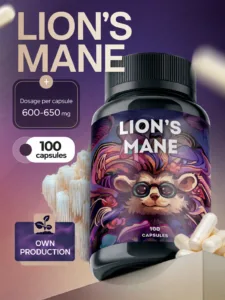
Capsules are not a third kind of material — they are packaging. What is inside is either powder or extract, and the label often makes it hard to tell.
This is the most common way people end up under-dosed. A 500 mg capsule of plain powder is roughly a sixth of the trial dose; taking two a day gets you nowhere near it. A 500 mg capsule of concentrated extract is a different proposition entirely.
Check: does the label say « extract » with a ratio or a beta-glucan figure, or just the mushroom name? If it is just the name, assume powder and do the arithmetic.
Use them if: convenience is what keeps you consistent — and consistency is the one thing the research clearly rewards.
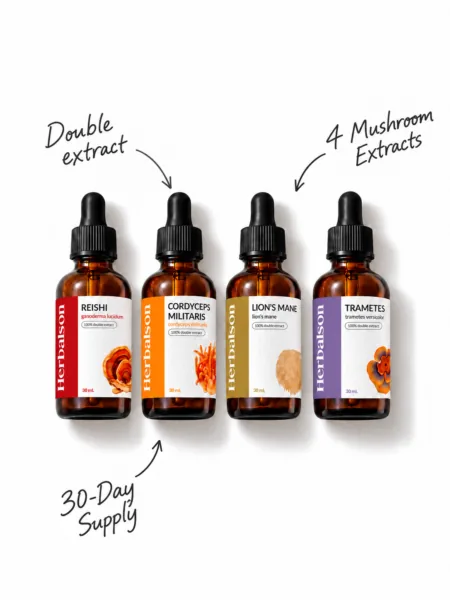
Coffret double extrait : crinière de lion, cordyceps, reishi et tramète versicolore | Lot de 4 teintures
Quatre doubles extraits de 30 ml dans une même boîte : crinière de lion, cordyceps, reishi et tramète versicolore. 1 ml de chacun par jour, pour un mois.
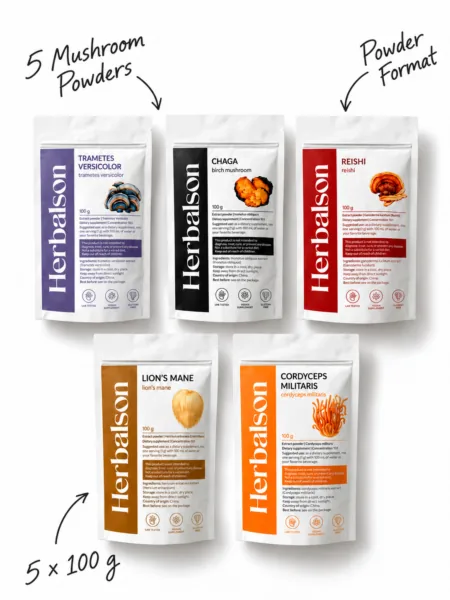
Coffret de poudres de champignons : crinière de lion, cordyceps, reishi, tramète versicolore et chaga | 5×100 g
Cinq poudres de corps fructifères de 100 g chacune : crinière de lion, cordyceps, reishi, tramète versicolore et chaga. Une portion de 3 g par tasse, environ un mois des cinq.
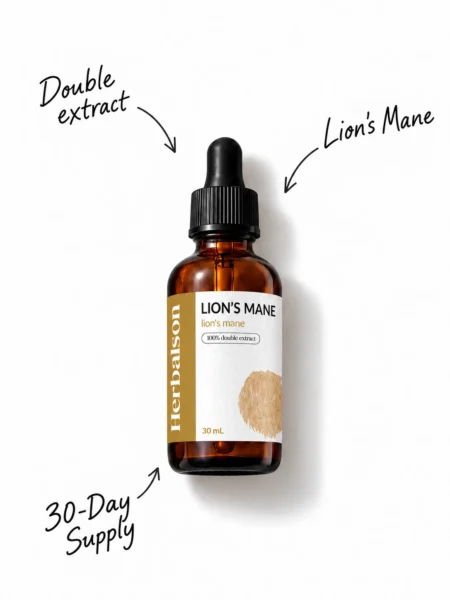
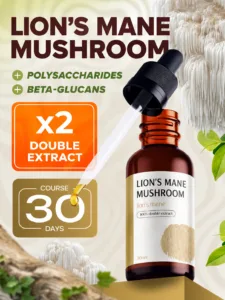
Double extrait de crinière de lion 30 ml | Soutien du cerveau et de la mémoire | Teinture d'Hericium erinaceus
Double extrait liquide de corps fructifères d'Hericium erinaceus, réalisé à l'eau chaude et à l'éthanol. 30 ml, 1 ml par jour, pour un mois.
Side by side
| Format | Typical daily amount | Cell wall opened? | Best for |
| la poudre | 2–3 g | Only if brewed or cooked | Cost, cooking, matching the trials |
| Hot water extract | ~300 mg–1 g | Yes, beta-glucans | Immune-focused species |
| Dual extract | 1 ml or ~300 mg–1 g | Yes, both groups | Lion’s mane, reishi, chaga |
| Gélules | Depends what is inside | Depends | Convenience and consistency |
Which species deserve which format
- Crinière de lion — dual extract. Beta-glucans need water; hericenones need alcohol. Water alone leaves half the mushroom behind.
- reishi — dual extract. The triterpenes that give reishi its bitterness are alcohol-soluble and a water-only product misses them.
- Chaga — dual extract or a long brew. Chaga tea is a legitimate traditional preparation, but it is a weaker, less consistent version of what an extract gives you.
- Tramète versicolore — hot water is the format the research used, since the compounds of interest there are the polysaccharide fractions.
- cordyceps — hot water covers the main compounds; the bigger question for cordyceps is whether you have real fruiting bodies at all.
What actually decides it
Two questions, in order:
- What is the source material? A fruiting-body powder beats a grain-grown mycelium extract every time. Format cannot rescue bad material — see our guide to fruiting body vs mycelium.
- What will you take every day for a month? The best format on paper is worthless in a cupboard.
Our dual extracts are 1 ml a day for a 30-day course; the powder set covers five species if you would rather brew. Both are fruiting-body material from our own farm.
Questions fréquentes
Is extract always better than powder?
Not automatically. A fruiting-body powder that you brew properly beats a vaguely specified extract of unknown material. Source first, format second.
Does the alcohol in a tincture matter?
Ethanol is the solvent, so yes, a dual extract contains some. In a 1 ml serving the amount is very small — comparable to what is in a ripe banana. If you avoid alcohol entirely, capsules or powder are the answer.
Can I just eat the mushroom?
For lion’s mane, yes — it is good food. You would need a lot of it to approach the studied amounts, and cooking does part of the extraction work, which is why traditional preparations always involved heat.
Do gummies count?
Check the actual mushroom content per gummy. It is usually low, and sugar makes up the difference.
Doubles extraits · Gélules · Poudres