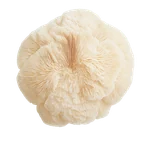
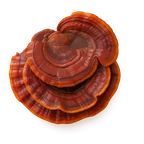
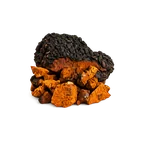
Chaga is the odd one out among functional mushrooms. It is not really a mushroom in the everyday sense, it cannot be used like the others, and it carries one safety consideration the rest do not. Here is how to actually use it — and the thing to check before you start.
What chaga is
Inonotus obliquus grows on birch, and the black, cracked mass you see on the trunk is not a fruiting body at all — it is a sclerotium, a dense mass of fungal tissue mixed with material from the tree itself.
That detail explains a lot. Part of what people value in chaga comes from the birch: betulin and betulinic acid are tree compounds the fungus concentrates. It also explains why chaga is almost always wild-harvested rather than farmed, and why the source matters.
Its other distinguishing feature is colour. The black exterior is loaded with melanin, and chaga is often cited for a high superoxide dismutase content — an antioxidant enzyme.
Start here: the oxalate question
This belongs near the top rather than buried in a footnote.
Chaga is high in oxalates. There is a published case of kidney damage in a person who took chaga powder daily for several years, and oxalate load is the mechanism implicated.
What follows from that:
- If you have kidney disease, reduced kidney function or a history of kidney stones, talk to a doctor before taking chaga at all.
- Do not treat it as something to take in large amounts indefinitely because it is „just a mushroom”.
- Stay hydrated, and keep to sensible servings rather than heaped spoonfuls of raw powder.
This is not a reason to avoid chaga if your kidneys are healthy. It is a reason to use it deliberately rather than casually.
Three ways to use it
1. Tea (decoction)
The traditional preparation, and it is a decoction rather than an infusion — chunks simmered for a long time, not steeped for five minutes. The chitin and the dense sclerotium tissue need heat and time.
Jak: simmer chunks in water well below boiling for at least an hour; many people go several hours. The same chunks can be re-simmered a few times until the colour weakens.
What you get: the water-soluble fraction — polysaccharides and some of the melanin. What you do not get is the alcohol-soluble material, including betulin.
Good for: a daily ritual, a coffee alternative, and the most forgiving way in. Do not boil it hard.
2. Powder
Convenient and the easiest to overdo. Raw powder stirred into a cold drink gives you a lot of undigested material — and with chaga, raw powder is exactly the form implicated in the oxalate case report.
Better use: treat powder as material for brewing rather than something to swallow by the spoonful. Simmer it, or add it to something cooked.
3. Dual extract
Water pulls the polysaccharides, alcohol pulls betulin and the triterpene fraction. Running both and recombining them is the only way to get both groups in one serving.
Good for: consistency and a known dose. A 1 ml serving is a defined amount, where a mug of home-brewed tea varies with every batch.
Our podwójnego ekstraktu z chagi is made this way from our own raw material, at 1 ml a day; the five-species powder set includes chaga if you prefer to brew.
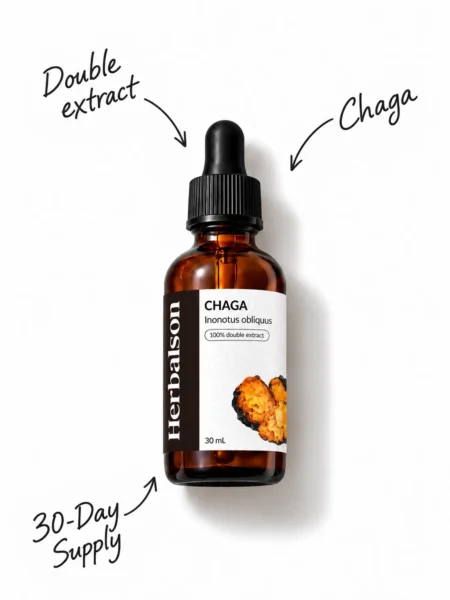
Chaga — podwójny ekstrakt płynny 30 ml | Przeciwutleniacz i wsparcie odporności
Płynny podwójny ekstrakt z dziko zbieranego Inonotus obliquus (chaga), wykonany gorącą wodą i etanolem. 30 ml, 1 ml dziennie, zapas na jeden miesiąc.
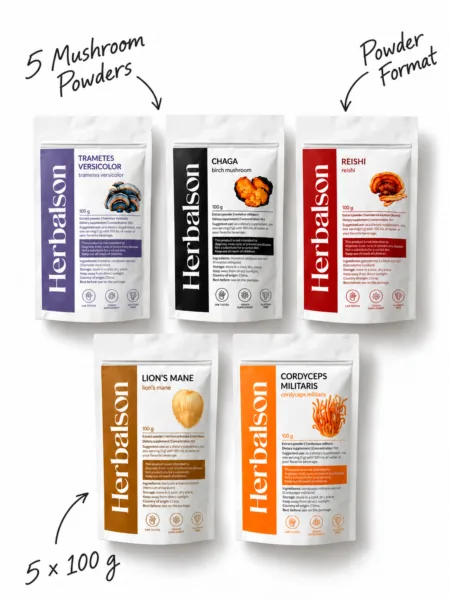
Zestaw proszków grzybowych: soplówka jeżowata, cordyceps, reishi, wrośniak różnobarwny i chaga | 5x100 g
Pięć proszków z owocników po 100 g: soplówka jeżowata, cordyceps, reishi, wrośniak różnobarwny i chaga. Porcja 3 g na filiżankę, na około miesiąc codziennego stosowania wszystkich pięciu.

Zestaw podwójnych ekstraktów: soplówka jeżowata, cordyceps, reishi i wrośniak różnobarwny | 4 nalewki
Cztery podwójne ekstrakty po 30 ml w jednym pudełku: soplówka jeżowata, cordyceps, reishi i wrośniak różnobarwny. Po 1 ml każdego dziennie, zapas na jeden miesiąc.
Tea or extract?
| Tea | Dual extract | |
| Compounds | Water-soluble only | Both groups |
| Dose control | Varies batch to batch | Defined per serving |
| Effort | Hours of simmering | Brak |
| Cost | Lower per cup | Higher per serving |
| Ritual | The main appeal | Brak |
Neither is wrong. Tea is a genuine traditional preparation and people enjoy it. An extract is the more predictable product.
Where it comes from matters more than usual
Chaga grows on living trees over many years and takes up what is in them and around them. Material harvested beside a road or from an industrial area is a different proposition from material with a known origin — and you cannot tell by looking.
Two more source questions worth asking:
- Is it birch chaga? Similar-looking growths occur on other trees and do not carry the same betulin content.
- Is it sustainably harvested? A conk takes years to form and removing it typically ends that growth. Demand has outpaced supply in several regions.
Practical notes
- Timing: any time. Chaga is not stimulating and not sedating; the tea makes a reasonable evening drink.
- Taste: mild, slightly woody, faintly vanilla. Much easier than reishi.
- Consistency: as with the others, a month before judging.
- Caution: besides the kidney question, ask a doctor first if you take anticoagulants or medication for blood glucose, or if you are pregnant or breastfeeding.
Częste pytania
Can I just boil it hard to save time?
A hard boil is not the same as a long simmer, and high heat is unnecessary. Low and slow is the point.
How many times can I reuse the chunks?
Usually three or four brews, until the liquid stops taking on colour.
Is chaga coffee a real thing?
Chaga tea is a common coffee substitute and holds up on its own. Blended „mushroom coffee” products vary enormously in how much mushroom they actually contain — check the amount per serving.
Can I harvest my own?
People do, but identification, tree species, sustainability and contamination all sit on you. If you go this route, take only part of a conk and leave the rest.
Is chaga safe daily?
For most people at ordinary servings, it is well tolerated. The oxalate consideration above is the reason to keep servings sensible rather than treating it as unlimited.
Chaga · Podwójne ekstrakty · Proszki