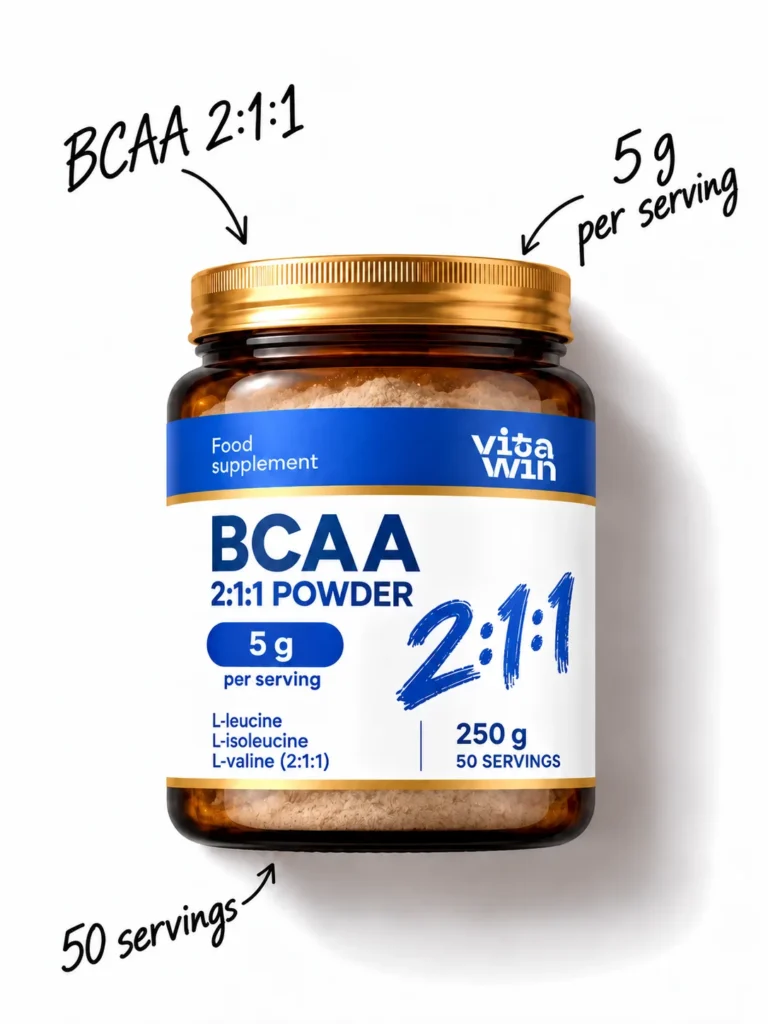
BCAA 2:1:1 powder is unflavoured leucine, isoleucine and valine in the ratio found in muscle protein. 5 g per serving, 250 g per pack, 50 servings.
What the branched-chain amino acids are
Leucine, isoleucine and valine are three of the nine essential amino acids — essential meaning the body cannot make them, so they have to come from food. They are called branched-chain because of their side-chain structure, and they are unusual in one respect: unlike most amino acids they are metabolised largely in muscle tissue rather than being processed by the liver first. Together they account for roughly a fifth of the amino acids in human muscle protein, and leucine is the one that carries the signal to the mTOR pathway, which is why it is doubled in the ratio.
Why 2:1:1
The 2:1:1 ratio — two parts leucine to one each of isoleucine and valine — mirrors the proportion in muscle tissue and is the ratio used in most of the published research. Higher-leucine blends (4:1:1, 8:1:1) push the signalling amino acid further at the expense of the other two. There is a reason to take either, so the range has both: see BCAA 4:1:1 tablets for the leucine-weighted version in tablet form.
BCAA or EAA
BCAA are three of the nine essential amino acids; building muscle protein requires all nine. If your total protein intake is high, BCAA around training is a convenience. If protein intake is low or the diet is plant-based, the full spectrum makes more sense — that is EAA essential amino acids powder. L-glutamine is the other amino acid commonly taken in the same window.
How to use the powder
Mix 5 g — one heaped teaspoon — with 300 ml of water and drink it before, during or after training. The powder is unflavoured, so it also goes into a protein shake or juice; pure BCAA have a distinctly bitter taste, which is worth knowing before the first glass. On non-training days, take it with a meal or skip it: it is not a daily requirement if you eat enough protein.
What is in a serving
- L-leucine, L-isoleucine, L-valine in a 2:1:1 ratio — 5 g total
- Unflavoured powder, no sweeteners or colours
- 250 g — 50 servings
Questions people ask
Before or after training?
Either; the practical difference is small. Convenience and consistency matter more than the exact timing.
Powder or tablets?
Powder is cheaper per gram and easier to dose at 5 g. Tablets are easier to carry — see BCAA 4:1:1 tablets.
Do I need BCAA if I use whey?
Whey already contains them, at roughly 20–25% of its amino acids. BCAA powder is for the training window itself, or for fasted sessions. Full list in amino acids.
Good to know. Do not exceed the recommended daily dose. Food supplements should not replace a varied, balanced diet and a healthy lifestyle. Talk to your doctor before use if you are pregnant, breastfeeding, taking medication or have a medical condition. Keep out of reach of children. Store in a cool, dry place away from direct sunlight.
These statements have not been evaluated by the Food and Drug Administration. This product is not intended to diagnose, treat, cure, or prevent any disease.