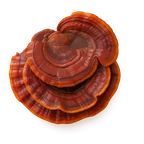
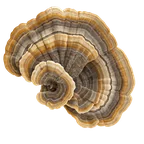
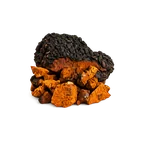
Turkey tail has the most substantial clinical literature of any functional mushroom — and also the widest gap between what that literature is about and what a supplement can claim. Getting that distinction right is the whole point of this article.
What turkey tail is
Trametes versicolor, formerly Coriolus versicolor, is one of the most common bracket fungi in the world. The concentric bands of colour give it its English name; in China it is yun zhi, in Japan kawaratake.
It is too tough to eat. It is used as an extract, and the compounds of interest are polysaccharide fractions rather than anything aromatic.
PSK and PSP: the important distinction
Almost every article about turkey tail cites the same clinical research. Here is what that research is actually about.
PSK (polysaccharide-K, sold as Krestin) is a protein-bound polysaccharide isolated from Trametes versicolor. In Japan it has been an approved prescription pharmaceutical since the 1970s, used alongside conventional treatment in oncology. PSP is a related protein-bound polysaccharide developed in China.
This is the crucial point: PSK is a regulated drug, produced to pharmaceutical specification, prescribed and dosed by doctors. It is not what is in a supplement jar. A turkey tail extract sold as a food supplement is a different product, made to a different standard, and it cannot borrow the drug’s clinical results.
When you read that “turkey tail is used in cancer treatment in Japan”, that sentence is about PSK. It is not about the capsules on a shelf.
What the human research covers
Stated factually, without extending it anywhere it does not go:
- Japanese meta-analyses examined PSK as an addition to chemotherapy after surgery in gastric and colorectal cancer, reporting survival differences in those settings.
- A systematic review examined yun zhi preparations and survival outcomes in cancer patients.
- A small US phase 1 trial gave a turkey tail preparation to women after breast cancer treatment, looking primarily at tolerability and immune markers.
- A small human study examined a turkey tail extract for its effect on gut bacterial populations, treating it as a prebiotic.
Three things follow, and all three matter:
- All of the oncology work is about a pharmaceutical preparation used alongside medical treatment, in patients, under supervision.
- None of it says anything about a supplement preventing or treating disease in a healthy person.
- A food supplement is not a treatment for any condition. Nothing on this page should be read as medical advice, and anyone with a diagnosis should be talking to their oncology team, including about supplements they are considering.
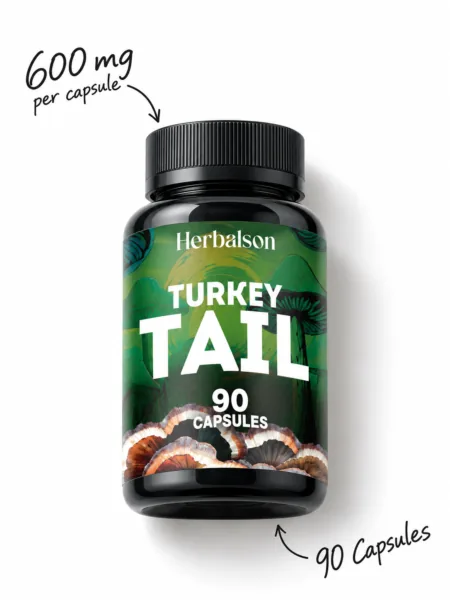
Turkey Tail Mushroom Capsules (Trametes versicolor)
Turkey Tail (Trametes versicolor) fruiting-body extract, 500 mg per capsule in an HPMC shell. 60 capsules, two a day — a 30-day supply.
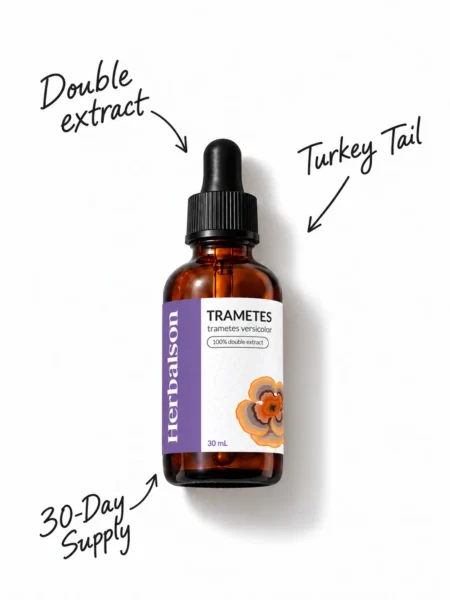
Turkey Tail Mushroom Double Extract 30ml | Trametes versicolor Tincture
Liquid double extract of Trametes versicolor fruiting bodies, made with hot water and ethanol. 30 ml, 1 ml a day, a one-month supply.
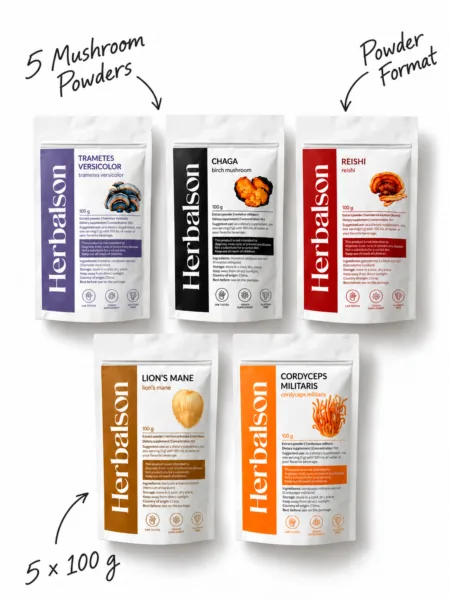
Mushroom Powder Set: Lion's Mane, Cordyceps, Reishi, Turkey Tail & Chaga | 5x100g
Five fruiting body powders of 100 g each: Lion's Mane, Cordyceps, Reishi, Turkey Tail and Chaga. A 3 g serving per cup, about a month of all five.
So why would a healthy person take it?
The honest answer is narrower than the search results suggest.
Turkey tail is a rich source of beta-glucans, the cell-wall polysaccharides studied for their interaction with the immune system, and it behaves as a prebiotic fibre — the small human study on gut bacteria is the most directly relevant evidence for someone who is well.
That is a reasonable basis for taking it as part of a routine. It is not a basis for expecting anything dramatic, and it is not a basis for any claim about disease.
Format and dosing
Turkey tail is the one species where hot water extraction is clearly the right format — the compounds studied are the water-soluble polysaccharide fractions, so alcohol adds little here compared with reishi or lion’s mane.
Look for beta-glucan content stated as a number. “Polysaccharides” on a turkey tail label carries the same problem as everywhere else in this category: on a grain-grown mycelium product, much of that figure can be starch. Our guide to fruiting body vs mycelium covers how to check.
Our turkey tail extract and capsules are made from fruiting bodies we cultivate ourselves, rather than foraged material of unknown origin — which matters for a species this common in the wild, since bracket fungi accumulate whatever is in their substrate.
Safety
Turkey tail is generally well tolerated; the commonly reported effects are digestive — gas, bloating, loose stools — which is unsurprising for a fibre-rich material. Darkening of the stool or nails has been reported with PSK in clinical use.
Ask a doctor first if you are undergoing any medical treatment, if you have an autoimmune condition, or if you are pregnant or breastfeeding, where there is no adequate data.
Common questions
Can I take turkey tail instead of a medical treatment?
No. It is a food supplement. The clinical research involves a pharmaceutical used in addition to conventional treatment, never as a replacement for it.
Is supplement turkey tail the same as PSK?
No. PSK is a specific, standardised pharmaceutical preparation. A supplement extract is a different product to a different standard.
What about turkey tail for dogs?
There is veterinary interest and some research, but our products are made and labelled for people. Anything to do with an animal’s health belongs with a vet.
Can I forage it myself?
Turkey tail is common and has look-alikes, and wild brackets take up contaminants from the wood and air around them. Identification is the smaller problem; provenance is the bigger one.
How long before it does anything?
Treat it like the others — a month of consistent use before judging, not a week.
Turkey Tail · Capsules · Double Extracts